Posts mit dem Label gt200 ade651 alpha 6 hedd1 h3 tec explosives detector thailand werden angezeigt. Alle Posts anzeigen

Montag, 30. Juli 2012

Why Can't Some Thai Officials Admit A Mistake?


Security forces spend $30 million on fake ‘bomb detectors’


BANGKOK — Thailand’s security forces bought more than 1,500 fake “bomb detectors” for $30 million, investigators say, and the armycurrently deploys them against Islamist rebels despite a U.S. Embassywarning that the devices are as useless as “a toy.”
The Department of Special Investigation (DSI) announced this month that the manufacturers and distributors of the devices fraudulently sold them to Thailand's military, narcotics bureau, airports and other security agencies. The DSI has sent the case to the National Anti-Corruption Commission for further investigation.
About a dozen government agencies purchased 1,576 the hand-held units, called GT200 and Alpha 6.
Despite the investigation and the U.S. Embassy warning, Thailand’s top defense officials insist the devices work.
“Do not say the GT200 used as a bomb detector in the far south does not work,” Defense Minister Sukumpol Suwanatat said last week, referring to southern Thailand where 40,000 troops are fighting Muslim separatists. “It has often detected explosives.”
More than 5,000 people have died in the conflict since 2004, and many were killed by bombs.
In 2006, the air force became the first Thai government department to buy the units. Mr. Sukumpol was the air force chief of staff at the time.
The army then purchased more than 750 GT200s, reportedly endorsed by Gen. Prayuth Chan-ocha, who is now army chief.
“I have seen the effectiveness of GT200 detectors in finding explosives,” the military’s SupremeCommander Thanasak Patimapakorn said last week.
However, some observers believe the military simply refuses to admit they made a mistake.
“For the military to admit that they were duped into buying useless bomb detectors … may invite unwanted investigation into suspected corruption,” wrote Bangkok Post’s former editor Veera Prateepchaikulearlier this month.
There is no public evidence of wrongdoing by military officials linked to the contracts.
After 2006, the Border Patrol Police Bureau, the Office of the Narcotics Control Board, the Justice Ministry’s Institute of Forensic Science, the Customs Department and other agencies purchased hundreds more of the devices.
The Defense Ministry’s Royal Aide-de-Camp Department — responsible for the security of Thailand’s king, queen, crown prince and other royal family members — also bought the equipment.
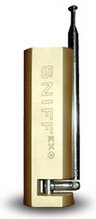
The DSI said a British company, ComsTrac, produced and sold GT200s and Alpha 6s to Thailand. The black devices include a small plastic box topped with a plastic cylinder, which can be gripped by hand.
However, British explosives expert Sidney Alford discovered the device was useless after examining one.
“That is an empty plastic case,” he told the British Broadcasting Corp. in 2010 after opening a GT200.
Mr. Alford added that a so-called “detection card,” which is supposed to be inserted into the device to identify explosives or drugs, is nothing more than a useless piece of paper.
The device also contains a collapsible, radio-style metal antenna that sticks out of the cylinder and swivels, supposedly to detect something. During security checks, nervous troops are ordered to slowly wave the device, making its antenna sway.
The army is still using most of its 750 GT200s in three Muslim-majority southern provinces where ethnic Malay-Thai Islamist guerrillas are fighting to secede from Thailand, which is 95 percent Buddhist.
Abhisit Vejjajiva, prime minister in 2010, said his government banned further purchases of the devices but allowed them to be used by the agencies that already had purchased them — even after discovering they were basically useless.
“We have done a double-blind test where the equipment was only successful in discovering [explosives] in 20 percent of the cases, when just a random choice would give you 25 percent,” he said.
In February 2010, the American Embassy in Bangkok alerted the U.S. National Security Council, Defense Intelligence Agency, CIA, and the Pentagon about Thailand’s use of the GT200.
A “confidential” report, released by the anti-secrecy website WikiLeaks, said the GT200 “looked and felt like a toy.”
The report said bomb squads in southern Thailand told embassy officials that “they never thought it worked, but they were ordered to use it.”
“To most people, the GT200 appears to be a glorified dowsing rod,” the embassy said.

Mittwoch, 17. Februar 2010

What Happens When Detectors Like GT200 Fail Another Test?


The government of Thailand viewed the recent actions of the British Government and finally listened to their own citizens in calling for the testing of the hundreds of GT200 detectors in use to find explosives.  As we previously reported, at least three Thai police officers were killed in a bombing where their GT200 showed no explosives to be present.  

The Bangkok Post has diligently been reporting on the scandal, and documented the failure of the GT200 in government tests, and plans to test the almost identical Alpha 6 detector which is used to find drugs. 

-------------------------------------------------------------


Abhisit scraps GT200 orders

Device registers 20% success rate in tests


The government will not buy any more GT200 substance detectors after test results showed the device performs worse than a roll of the dice.

The decision came after Prime Minister Abhisit Vejjajiva was briefed yesterday on the test findings by Science and Technology Minister Khunying Kalaya Sophonpanich.
Tests were conducted on Sunday after the effectiveness of a similar British-made bomb detector, the ADE651, was criticised and it was banned by the British government.
The tests consisted of 20 trials in which explosives were placed in one of four boxes. The device succeeded in recording just four correct readings.
The cabinet has issued an order to all state agencies to abandon any plans to buy any more of the device, the prime minister said.
Mr Abhisit said using the device over the long run would place authorities in the field at risk. He called for a review of the use of the detectors by all agencies.
The Science and Technology Ministry was instructed to send the tests results to all agencies that use the device so they had a better understanding of why they should no longer use the equipment.
Mr Abhisit said he was surprised that authorities in the field still believed the detectors were effective at detecting bombs.
He said there was no recommendation as to what equipment or alternative methods should be used if the use of GT200 was discontinued.
The government would investigate whether there were irregularities in the purchases of 818 GT200 detectors, he said. The device is used by the army, the air force, police force, the Customs Department and the Central Institute of Forensic Science.
Khunying Porntip Rojanasunan, of the Central Institute of Forensic Science, and the army yesterday opted to continue using the device.
Khunying Porntip said her institute had found the device effective.
"I've said GT200 is not a scientific device." she said.
"Its efficiency also relies on human interactions. The institute has found it effective as a supplementary device."
An army source said army commander Anupong Paojinda had instructed army personnel in the three southernmost provinces to continue using the GT200.
"There is no order prohibiting its use," the source said. "But the purchase plan is put on hold."
The units handling the device have been instructed to submit reports on its operations, the source said.
Local residents in the South yesterday called for the scrapping of the use of the device in public places following the test results.
Nimu Makaje, chairman of the advisory council for peace-building in Yala, said if agencies insisted on using the equipment, the operations must be limited to their units only.
"It must not be used to search or do anything with the people because problems will follow," he said.
"The test results clearly show they are not effective."
Human rights activist Angkhana Neelaphaijit urged the government to find ways to compensate the "victims" of the GT200 device.
She said many innocent people had been wrongfully identified as suspects by the device since it was introduced in the three southernmost provinces.
The use of sniffer dogs is being urged as an alternative, but Poj Paiboonkasemsut, president of the chambers of commerce in five southern provinces, issued a word of caution due to differences in religious faiths and cultures.
"The use of sniffer dogs to search for illegal substances is good but authorities should be sensitive to people's cultural and religious backgrounds," Mr Poj said.
Democrat MP for Narathiwat Jehaming Toktayong said yesterday another test of the GT200 might be conducted following a complaint about possible contamination of the test venue.
Mr Jehaming said one of the test committee members suspected explosive contamination which could have skewed the test results.
He said that once a formal complaint was lodged he would proceed with it and press for a fresh test.


 -----------------------------------------------------------------------------------------------------------

Questions About The Article

Bravo to Bangkok Post for the continued reporting on this scandal!


However, the article should clarify a few things.   


The GT200 is NOT 20 percent effective at finding explosives.  It is as effective as randomly guessing.  In this trial, it was actually less effective, but statistically over time it would be shown to be the same as guessing which box had the explosives, rolling dice, or flipping a coin.   The reason the GT200 was able to correctly find the explosives 20 percent of the time was because one box in 4 held the sample.   That does NOT mean the GT200 detector worked 20 percent of the time.   It did not work at all!  It was ZERO percent effective at helping find the explosives.   If there had been 2 boxes to pick from, would you say it was 50 percent effective?  If there were 10 boxes and only one held the sample, would you say it was only 10 percent effective when on average it pointed to the correct box one time in 10?  What about 100 identical boxes, or 1000?  If a clock is stopped, is it not just luck or coincidence that occasionally the real time matches the broken clock? It does not mean the clock itself suddenly started working that moment, it is a coincidence.  


Why is the Army in Thailand allowed to continue to use the GT200 after it completely failed these tests?  It does not work!   Another article mentioned soldiers using chopsticks in place of the GT200 detectors to find explosives.  Hopefully they were doing this sarcastically to prove the stupidity of the prior issuance of the GT200.   But even if they were not, at least the government saved money and the soldiers knew they were holding just a stick of wood, instead of an equally useless metal antenna that had been falsely described as a detection device.